
Executive summary
Most trade schemes move volume forward rather than create it. This guide covers scheme design against retailer economics, enrollment mechanics observed during the Aashirvaad Utsav rollout at ITC Limited, and an evaluation framework built on sell-out, retention and incremental throughput rather than sell-in.
Key takeaways
- Design the scheme against retailer cash flow, not just retailer margin.
- Enrollment friction, not attractiveness, is usually the binding constraint.
- Sell-in spikes prove nothing; sell-out and post-window retention do.
- The best schemes change stocking behaviour permanently, not for a month.
Key highlights
- — Field-observed enrollment barriers from a live scheme rollout
- — A four-metric scheme evaluation scorecard
- — Why slab schemes and free-goods schemes behave differently
Start with retailer economics, not brand objectives
A retailer evaluates a scheme on three things: cash locked, shelf space consumed and speed of rotation. A high headline margin on a slow-moving pack is a worse offer than a modest margin on a fast rotator, and the field conversation will make that obvious immediately.
- Cash outlay required to qualify for the slab.
- Days of stock the qualifying quantity represents.
- Whether the benefit arrives as goods, credit note or instant discount.
Enrollment friction is the real constraint
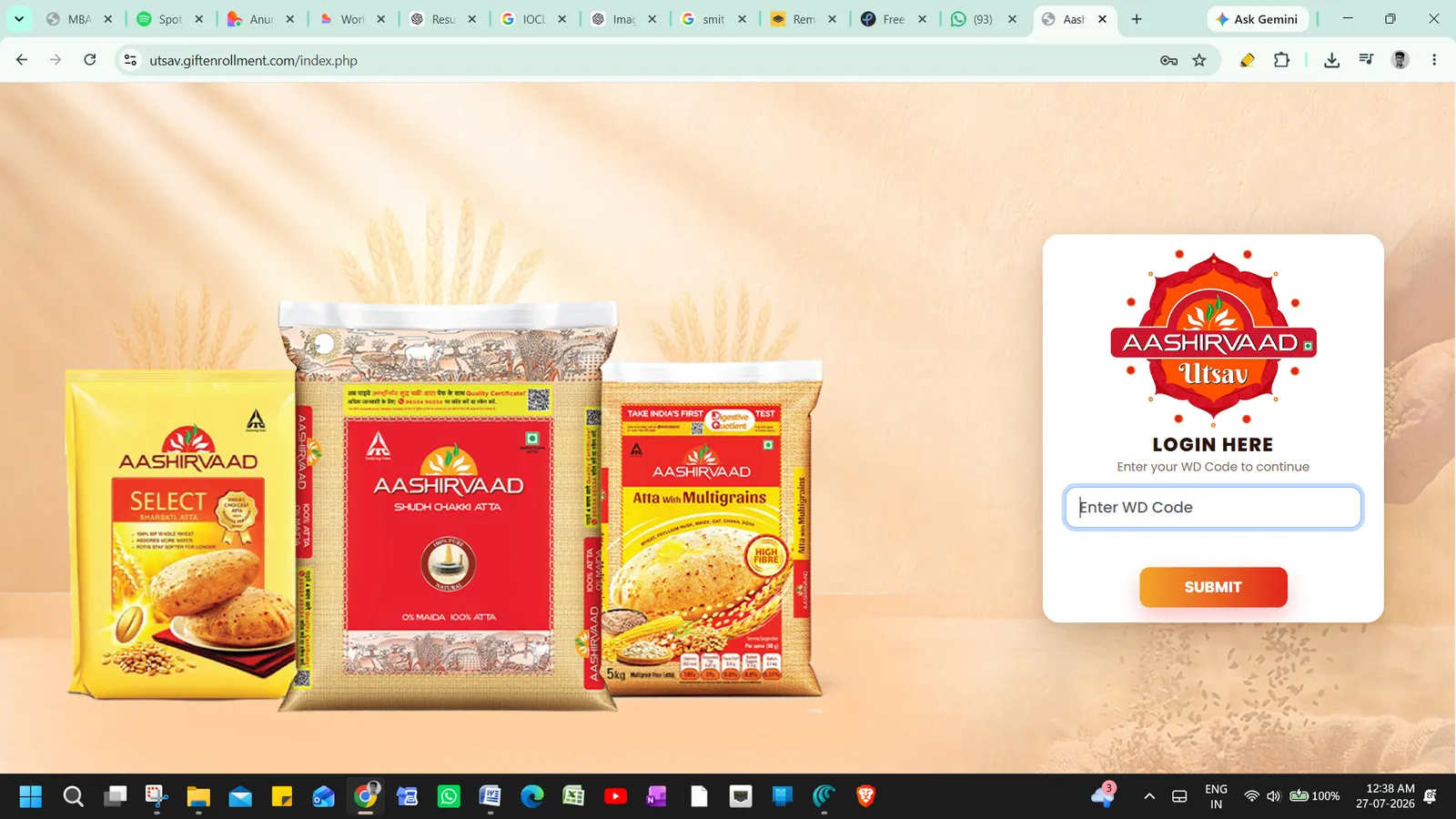
During the Aashirvaad Utsav rollout, the scheme itself was rarely rejected on value. The drop-offs came from process: unclear qualification rules, digital enrollment requiring details retailers did not have to hand, and uncertainty about when the benefit would actually land.
Removing one field from an enrollment step reliably beat improving the offer by a percentage point.
Execution: make the promise legible at the counter
Schemes work when the retailer can explain them in one sentence without reading a leaflet. Print the slab, the benefit and the settlement date on a single card, and repeat the same wording across the salesperson's pitch, the enrollment screen and the invoice note.
Evaluate on four numbers
Enrollment rate against the eligible universe, incremental throughput per enrolled outlet versus a matched control, sell-out versus sell-in during the window, and retention of ordering behaviour in the two months after it closes.
A scheme that scores well on the first three and badly on the fourth has purchased forward buying at a discount.
Important definitions
- Sell-in
- Volume billed from the company or distributor into the retailer.
- Sell-out
- Volume actually sold by the retailer to shoppers.
- Forward buying
- A retailer stocking ahead of demand to capture scheme benefit, borrowing volume from future periods.
My perspective
Executing a live scheme taught me that trade marketing is mostly operational empathy. The economics were designed centrally, but the outcome was decided by whether a busy shop owner could understand, trust and complete the process in the ninety seconds he was willing to give us.
Conclusion
Good trade schemes respect retailer cash flow, minimise enrollment friction, communicate in one sentence, and are judged on behaviour that outlives the window. Design for the ninety seconds at the counter and the arithmetic tends to follow.
Key learnings
- Friction removal outperforms offer enrichment.
- Legibility at the counter is a design requirement.
- Post-window retention is the honest measure of a scheme.
Frequently asked questions
- What is a trade scheme in FMCG?
- A trade scheme is a time-bound commercial offer to channel partners — slabs, free goods, credit notes or visibility payments — designed to secure stocking, visibility or throughput.
- How do you measure trade scheme ROI?
- Compare incremental throughput per enrolled outlet against a matched control, net of scheme cost, and check whether ordering behaviour persists after the scheme window closes.
- Why do retailers refuse attractive schemes?
- Usually because of cash lock-in, slow rotation risk, unclear qualification rules or doubt about when the benefit will actually be settled.
Go deeper
Suggested reading

FMCG Beat Planning & Route-to-Market Strategy — A Field Guide
A practical guide to FMCG beat planning and route-to-market strategy, built from covering 37 market beats and 400+ retail outlets at ITC Limited.
Consumer Insights From the Field: Turning 400 Conversations Into Decisions
A consumer insights guide: interview design, separating facts from insights, coding qualitative data and writing insights that lead to action.
Internship Diary: What 400+ Retail Outlets Taught Me at ITC Limited
A field diary from an FMCG internship at ITC Limited — 37 market beats, 400+ outlets and the lessons an MBA classroom cannot teach.
Newsletter
New frameworks, field notes and case studies — occasionally, never noise.
Get new Knowledge Hub articles on marketing, business analytics and product management as they are published. Email me to be added to the list.
Subscribe by emailComments
Discussion is not open on this site yet. Thoughts, disagreements or corrections are genuinely welcome — send them directly.